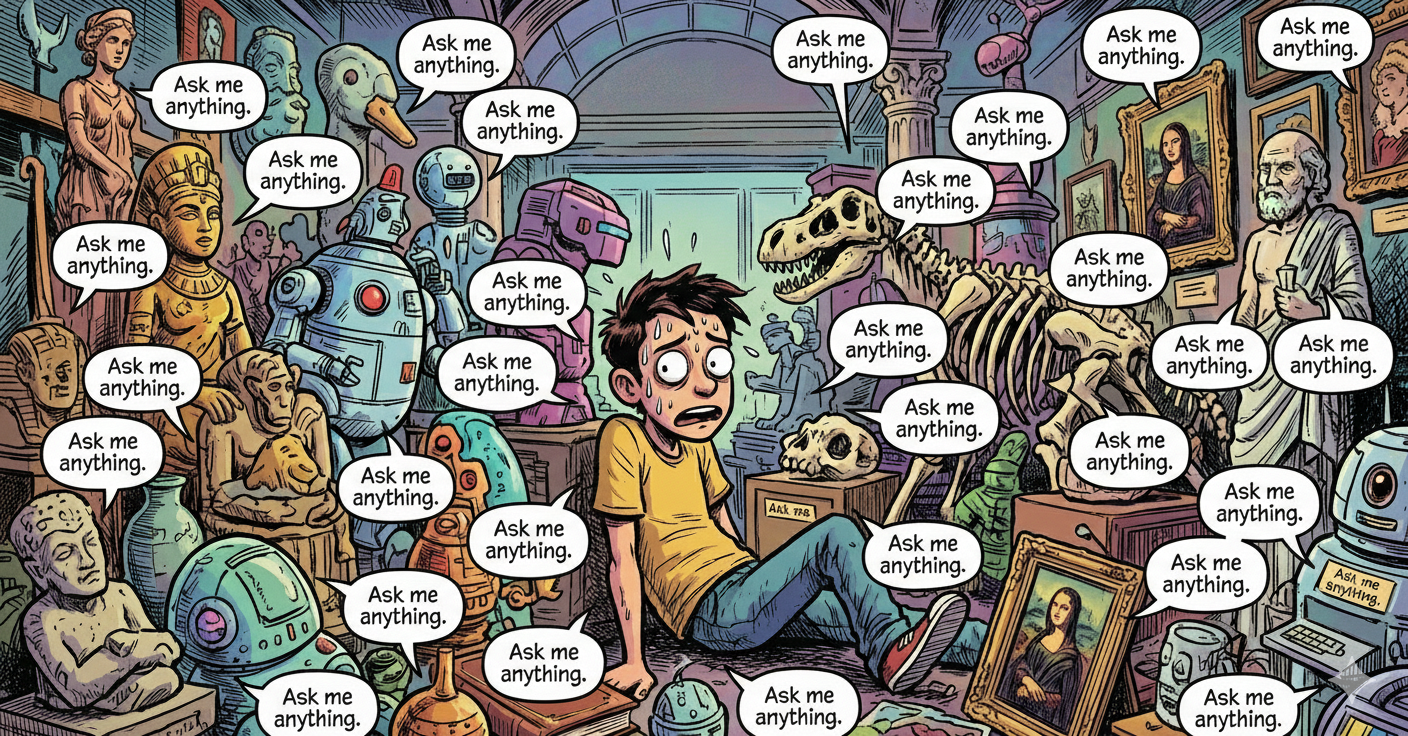

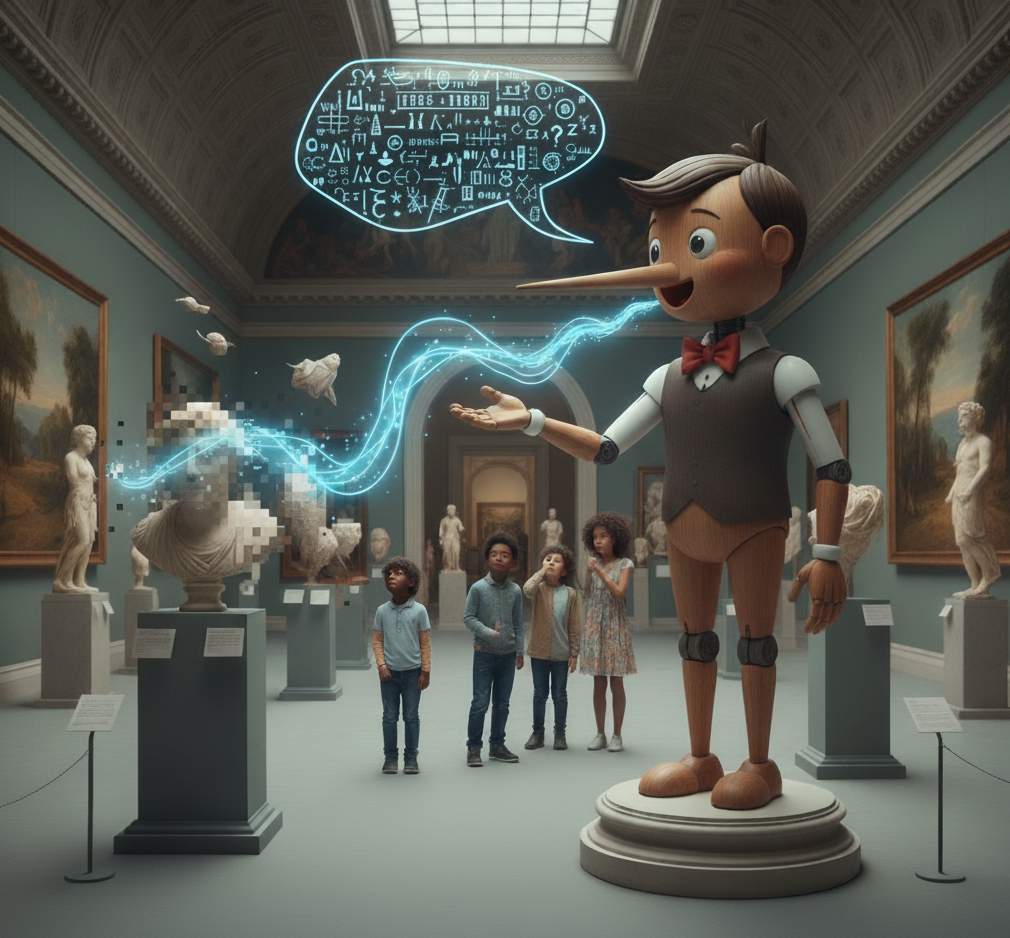
Who hasn’t experienced this? You ask an AI a question and get an answer that is astonishingly self-confident, but unfortunately completely wrong. These moments, when the technology seemingly becomes “creative” and invents facts, are called AI hallucinations.
While this is often just an annoyance or a curiosity in everyday life, it becomes a serious problem in a professional environment. Especially for institutions whose core task is based on verified facts and public trust, such as museums, such hallucinations are unacceptable.
What are AI hallucinations?
The term “AI hallucination” describes a phenomenon in which an AI model generates seemingly convincing, but false or freely invented information.
As IBM explains, such errors arise when a Large Language Model (LLM) “perceives” patterns that do not exist in the training data and derives content from them that does not correspond to reality (IBM, 2024).
Unlike a classic programming error, the AI does not consciously make things up, but rather calculates the most probable answer based on its training data. If this data is incomplete or distorted, a seemingly plausible but factually incorrect statement, a hallucination, arises.
Why do LLMs hallucinate?
Large language models are trained to predict the most probable sequence of words. They do not understand content in the human sense, but rather calculate probabilities.
Since they are based on predefined datasets with a limited “knowledge cutoff”, they lack current or specific facts.
So, if a model doesn’t “know” reliable information, it fills the gap and generates an answer that sounds fluent but is not based on verifiable sources.
Such hallucinations can also be caused by bias in training data, misinterpretations during text generation, or a lack of constraints in prompt design.
Why is this problematic for museums?
Museums are places where visitors expect high-quality, verified information.
A study by the Institute for Museum Research (2023) shows: “Museums enjoy the highest level of trust among all knowledge institutions in Germany” (SMB, 2023).
If museums use AI-supported systems in the future, such as chatbots, audio guides, or visitor assistants, this trust is at stake.
An AI that misinterprets historical data, invents an object’s context, or even distorts sensitive topics can damage credibility and trust in the long term.
Especially in the cultural sector, it is therefore crucial: Whoever uses AI must secure the factual basis.
How can hallucinations be prevented?
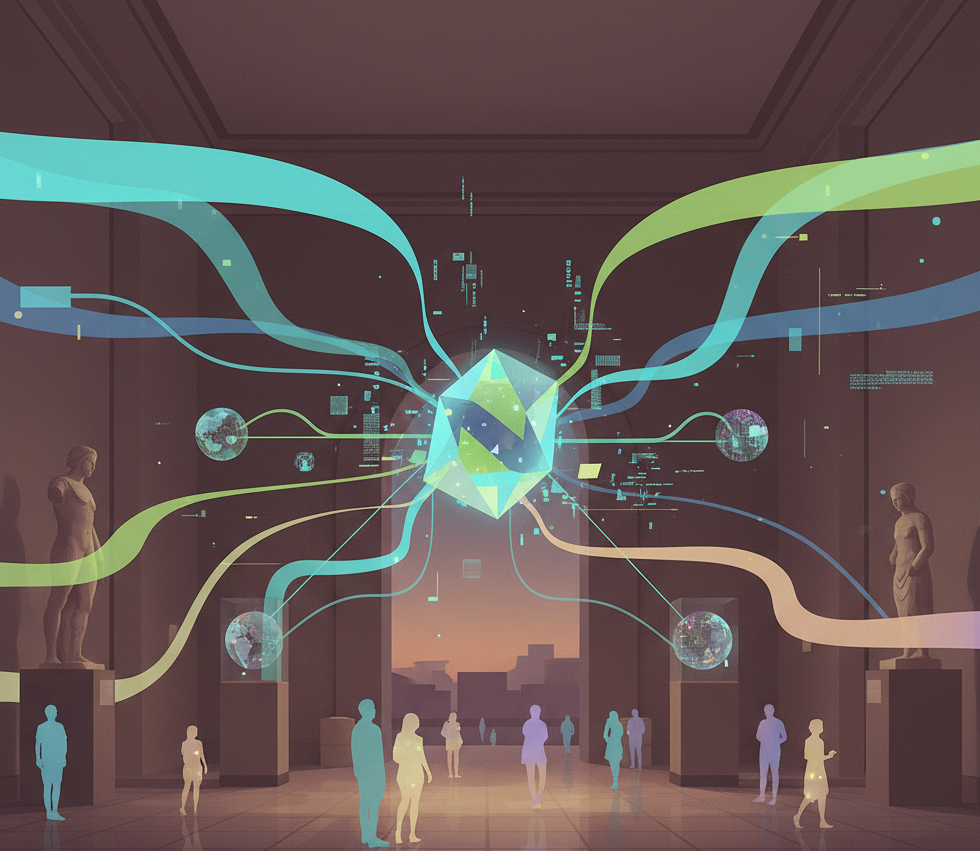
A proven method to avoid AI hallucinations is Retrieval-Augmented Generation (RAG) (Wikipedia_RAG).
RAG combines two steps:
-
Retrieval: The AI searches an external knowledge database or document collection for relevant information.
-
Generation: Only this verified content is built into the answer.
In this way, the AI is not limited to its internal language model but can draw on fact-checked, current sources.
RAG models are increasingly being used as a best practice for knowledge-intensive areas such as medicine, law – and, indeed, museums.
Different requirements depending on the domain
A RAG system does not work universally the same.
Depending on the area of application, search and response mechanisms must be adapted:
-
Museum databases often consist of descriptive texts, metadata, provenance information, and object images.
-
The type of questions differs greatly from typical web search queries – visitors might ask, “Who was this artist?” or “What is the meaning of this symbol?”.
-
The type of answer also requires domain knowledge: An AI assistant must not only formulate correctly, but also context-sensitively and visitor-friendly.
nuseum as an expert for RAG in the museum sector
nuseum develops AI-supported museum guides that are specially designed for these requirements.
The nuseum Copilot uses a RAG system tailored to the museum domain:
-
It accesses curated data sources and verified object information before generating an answer.
-
This allows the chatbot to supplement visitors’ missing background knowledge without inventing content.
Through the combination of technical RAG expertise and an understanding of museum educational practice, nuseum supports museums in using AI safely – as a tool for knowledge transfer, not as a risk to their credibility.
Conclusion
AI hallucinations are not a marginal phenomenon, but a structural risk of generative models.
Museums in particular, which are regarded as trustworthy places of knowledge, must ensure that digital educational offerings remain fact-based.
Technologies like Retrieval-Augmented Generation offer a future-oriented solution here:
-
They combine machine language competence with curatorial responsibility.
nuseum shows how both can be combined in practice, for digital assistants that answer visitor questions reliably, context-accurately, and credibly.
Further Sources