
“Talk to a Roman Emperor” or “Chat with a Van Gogh painting”—headlines like these have frequently served as prime examples of how museums are embracing the latest state-of-the-art technology. However, while positioning themselves as undeniably futuristic, many institutions’ “eagerness to innovate” often obscures the question of to what extent such approaches actually meet the needs and challenges of their visitors.
At Nuseum, we believe that technology should never be used for its own sake. The focus must remain on the visitor experience. For a museum visit to be successful, barriers and points of friction must be eliminated as much as possible. Here, you will learn why a pure chat interface creates new barriers and why we have chosen a different path.
The Novelty Trap: Why "Ask Anything" Fails After Object No. 5
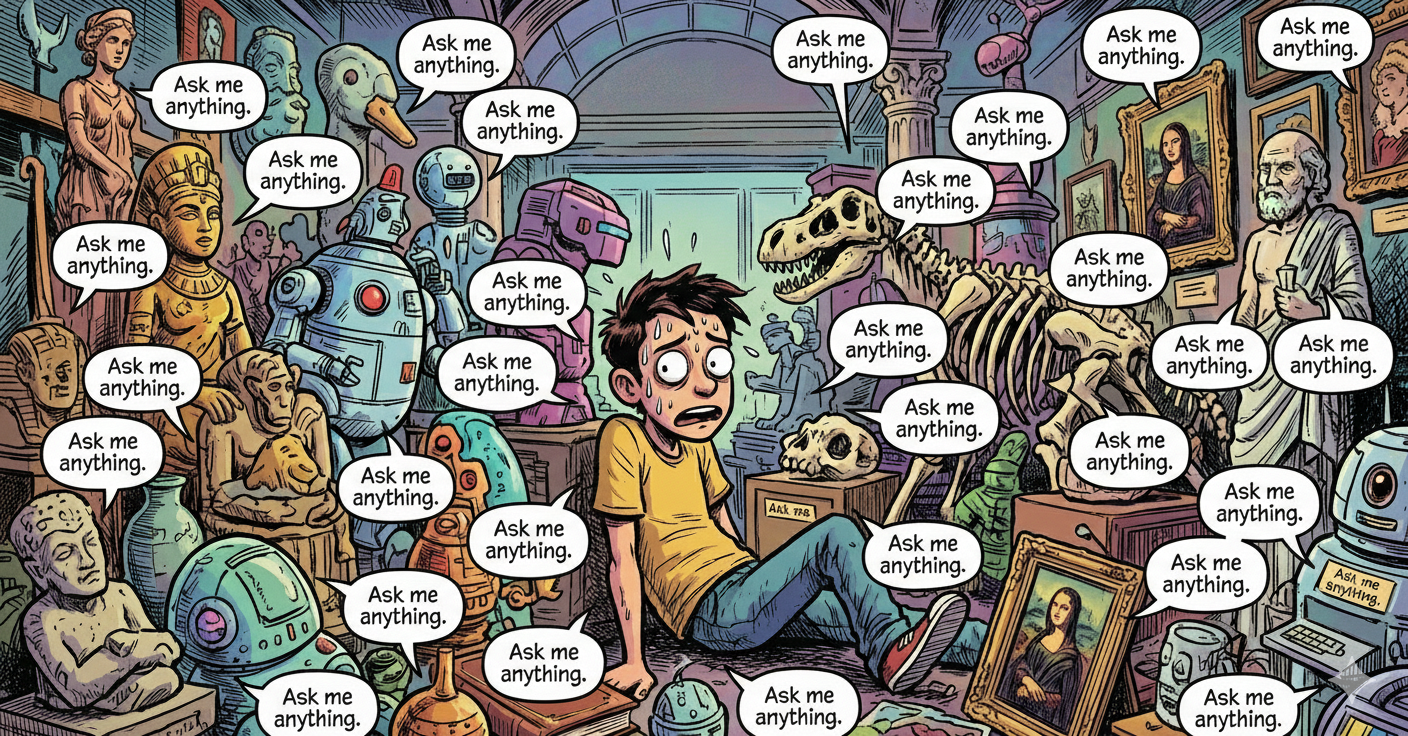
The invitation to “Ask me anything!” is fun for the first one or two paintings. It feels novel to see an AI respond. But as you move through an entire wing of a museum, this interface becomes a significant barrier.
The Effort Gap: Having to constantly think of, type out, and correct questions on a small screen is effortful. After 10 objects, what started as fun feels like a chore.
The “Unknown Unknowns”: To ask a good question, you often need a baseline of knowledge. If you don’t know the political context of a Renaissance portrait, you don’t even know what to ask. Research on Cognitive Load Theory shows that forcing a visitor to do all the “heavy lifting” leads to rapid mental fatigue.
By the time you reach the third room, the chatbot is no longer an assistant—it’s an obstacle between you and the art.
The Limits of the "Old Way"
Traditional audioguides aren’t the answer either. They solve the “work” of the chatbot by providing a narrative, but they have their own walls:
Static & Passive: Everyone hears the same script, and there is no way to dive deeper when a specific detail grabs you.
The Jargon Barrier: They often use academic language that feels exclusionary.
As explored in The Rise of Chatbots in Museums, the sector is searching for a way to use AI to bridge these gaps without exhausting the visitor.
Removing Barriers to Ignite Curiosity
At Nuseum.ai, we don’t just add tech; we use it to strip away the friction that prevents people from connecting with history.
1. Language: The First Barrier
We believe that every language except the mother tongue is a barrier. Deep emotional connection to an object is hard when you are busy translating in your head. We offer support in over 20 languages and use AI to ensure the language used is clear and simple. We remove the barrier of academic jargon so the story can shine through.
2. Narrative First, Questions Second
A great museum visit should feel like a story, not an interview. Nuseum provides a clear narrative thread for visitors to follow, providing context and setting the stage just like a professional human guide. We remove the “unclear navigation” barrier by giving you a path to follow—igniting curiosity naturally rather than demanding it.
3. "Discovery Layers" via Subchapters
Human beings remember information better when they choose it based on their own interests. Instead of a single forced script, we use Discovery Layers. These optional subchapters allow you to “follow the rabbit hole” on your own terms. You get the depth of an AI without the effort of typing.
4. Optional Interaction: Your Expert in Residence
We haven’t removed the ability to ask questions—we’ve made it a feature rather than a requirement. Our open question tool is there to clarify misunderstandings or follow a specific niche interest. It is a powerful resource that is available when desired, but never a chore. It turns the AI from a demanding chatbot into a helpful expert in your pocket.
The Verdict
The goal of museum technology should be to disappear into the background. The best experience is one where the visitor forgets they are using a tool and simply feels a direct, emotional connection to the art.
By moving away from “chat-only” traps and focusing on narrative-driven, layered storytelling, we aren’t just giving visitors more information—we are giving them their curiosity back.